Anubias barteri var. glabra
$15.99
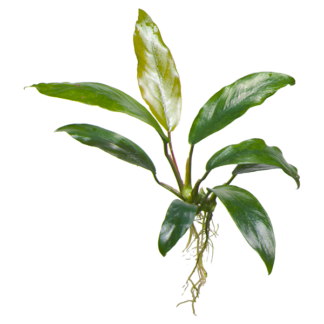
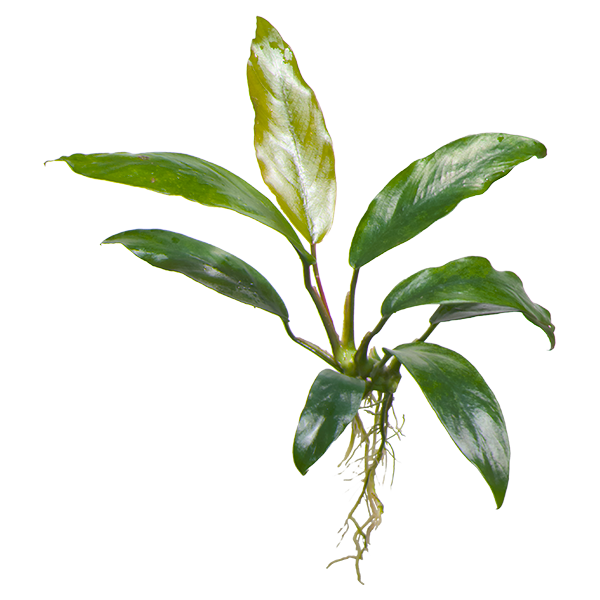
A rhizomatous epiphyte with narrow, lance-shaped dark green leaves and slow growth, usually attached to rock or driftwood in the midground or foreground of low- to medium-light aquariums.
- Scientific Name
- Anubias barteri var. glabra
4 in stock. Ships from Richmond, BC.
Note: Pictures are for reference only, and may not look exactly the same.
Description
Anubias barteri var. glabra is an aroid in the family Araceae from West and West-Central Africa. It grows on rocks and riverbanks in and along forest streams, in the flood zone where it is exposed to submerged and emergent conditions. The plant has a creeping rhizome that produces roots and leaves along its length. Leaf blades are narrowly elliptical to lance-shaped, pointed, somewhat asymmetrical, dark green and slightly glossy, typically 10-15 cm long and about 3 cm wide on mature plants. Submerged growth remains smaller than emergent growth, and height is typically 10-20 cm submerged and up to about 25 cm in emergent culture.
Growth is slow, at roughly one to two new leaves per month under moderate conditions. The variety is variable, and several forms circulate in trade under the synonyms Anubias lanceolata and Anubias minima. Small narrow-leaved plants are sold as A. barteri var. glabra ‘Minima’, and the plant is sometimes mislabeled as A. barteri var. angustifolia or ‘Anubias congensis’. Leaves are firm and persist for months, so older foliage tends to collect biofilm and algae.
Care
Low to moderate light in the 10-50 PPFD range supports steady growth. Water temperature is kept at 20-28 °C, with the strongest growth near 22-26 °C. pH 5.5-8.0, dGH 2-15 and dKH 0-15 are tolerated. CO2 is not required; 0-30 ppm is tolerated, and injection increases leaf production. Nutrients are taken mainly through the leaf surface, so a liquid all-in-one fertiliser dosed once or twice weekly is sufficient; iron shortage shows as yellowing new leaves. Additional water movement near a filter outlet, within a gentle to moderate flow of about 0-10 cm/s, increases growth rate.
The rhizome is tied or glued to rock or driftwood, or wedged between stones in the midground or foreground. It can be set into coarse gravel, but the rhizome remains above the substrate. Because leaves remain in place for months, they collect biofilm and green spot algae. A photoperiod near seven to eight hours, phosphate below about 2 ppm, and shaded positions in high-light tanks reduce algae on the leaf surfaces. Nerite snails and Amano shrimp graze the leaf surfaces without damaging them.
The rhizome is not buried. A covered rhizome rots within weeks and the plant dies back from the base.
Propagation
Propagation is by division of the rhizome. A sharp blade cuts through the rhizome so each section carries at least three or four leaves and a portion of roots. Each section is attached to rock or driftwood with gel glue or thread, and the cut surface remains exposed to water rather than pressed into substrate. New growth resumes from the rhizome tip within two to three weeks. Division is usually carried out during routine maintenance, because it disturbs the mounting position of the parent plant.
Trimming
Yellowing, damaged or algae-covered leaves are cut at the petiole close to the rhizome. The removed leaf does not regrow, but new leaves emerge from the rhizome tip. Roots that extend past the hardscape are shortened when they collect debris. Where the rhizome has spread beyond its mounting point, the front portion is cut and reattached. Leaf surfaces are wiped during water changes before algae become established.
Appearance
- Shape: epiphytic, rhizome
- Size: medium
- Can Grow To: 25 cm tall
- Color: dark green
Notes, Tips, and Considerations
-
Leaves and rhizome are firm; herbivorous fish generally do not graze them, so the plant persists in tanks with cichlids and other plant-eating species.
-
Submerged pot-grown specimens may carry snails or other invertebrates; inspection and treatment are needed before the plant is placed in a tank.
-
Trade naming is inconsistent. The same plant is sold as Anubias lanceolata and Anubias minima, and small forms are labeled ‘Minima’ or ‘Kruising’.
-
Higher light increases algae on the leaf surface more than it increases leaf production; moderate light with good flow produces more new leaves than strong light alone.
-
The plant also grows emersed in humid terrariums and paludariums, where leaves are larger than in submerged culture.
Naturally Found
- Regions
- Africa
- Directions: West, Central
- Countries: Guinea, Ivory Coast, Liberia, Nigeria, Cameroon, Gabon, Congo
- Africa
- Environment
- Habitat: river, marsh, wetland
- Water Type: freshwater
- Water Depth: 0 – 1.5 m
- Water Flow: slow, moderate
- Light: low, medium
- Temperature: 22 – 28 °C
- Humidity: high
- Substrate: rock, mud
Related products
-
 BeginnerForegroundCarpeting
Littorella uniflora
$13.99 Details -
Sale!
 BeginnerBackground
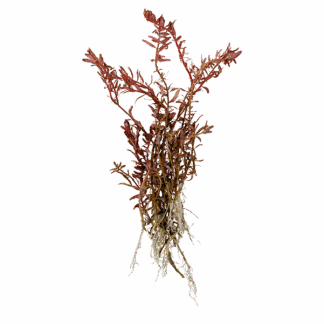
Rotala rotundifolia ‘red’
Original price was: $10.99.$3.99Current price is: $3.99. Add to cart -
Sale!
 BeginnerBackground
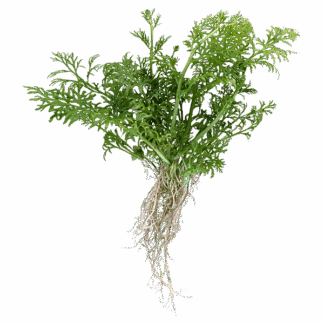
Water Sprite
Ceratopteris thalictroidesOriginal price was: $11.99.$6.99Current price is: $6.99. Add to cart